
Maidencreek Township Authority Useful Tidbits
How much Water Should a Typical Homeowner Use?
A typical person uses approximately 45 gallons of water per day. Assuming a usage of 45 gallons per day per person, a family of four (4) will use 16,200 gallons of water per quarter. A household of two (2) will use 8,100 gallons of water per quarter. If you are using less water than average, you and your household are doing its part to conserve water.
How Can I Reduce My Water and Sewer Bill?
Leaking toilets are the number one cause of high-water usage. A small leak or worn-out flapper can leak at a rate of 0.10 gallons per minute. This doesn't seem like much, but a worn-out flapper valve leaking at 0.10 gallons per minute will increase your water and sewer usage by 13,000 gallons per quarter. An additional 13,000 gallons per quarter will increase your water and sewer bill by an additional $190.82 per quarter. It pays to check and replace worn out parts on your toilets! High
water use can also come from shower use. Customers should consider switching to a low-flow shower head if they wish to further reduce water consumption. Other common items contributing to high water usage are water softeners and other treatment units cycling too often and water heater and pressure reducing valve malfunctions.
Check Toilets for Proper Operation:
A common phrase is “My toilet isn't leaking; I would hear it”. Most of the time, you can't hear the toilet leaking. To properly check if a toilet is leaking, you can pick up blue-dyed tablets at the Authority's Office (1A Quarry Road, Reading, PA 19605) and follow the directions on the packet. Another quick test is to sprinkle black pepper in the toilet bowl. The black pepper should stop moving. If it continues to move in the bowl after a few minutes, you have a leaking toilet.
When Taking Extended Trips, Turn Off Your Water:
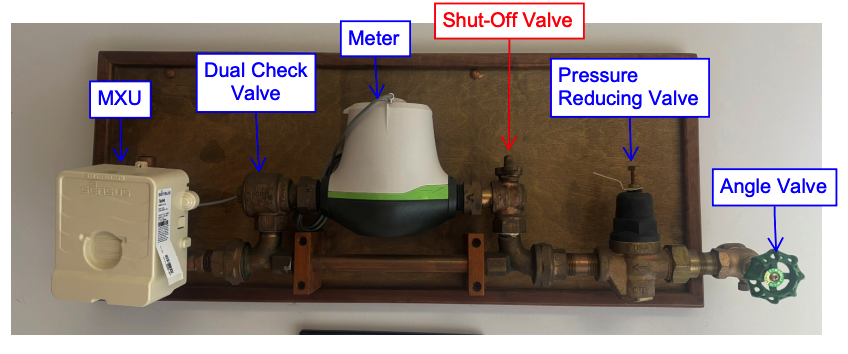
Customers should consider shutting the main water valve to the home when the home is vacant for an extended time. This valve is usually located before the water meter. Remember to be aware of your home's heating system requirements when shutting down the main water valve. It is good practice to exercise this valve on a regular basis. It is also good to know where this valve is located and how to operate it in the event of an emergency. The Authority is able to shut the water off by the street that services your property; however, if there is a leak in the plumbing system inside your home, it is always quicker to know where and how to turn off the water to mitigate potential damages inside your home. An example of what the shutoff valve could look like is provided below.
Call the Water & Sewer Authority Before Calling a Plumber:
The Authority is responsible for the repair and maintenance of the water and sanitary sewer lines from the water and sanitary sewer main in the street to your property line (Public Right of Way Line). The Authority's responsibility for the water service line ends at the outlet side of the curb stop shut off valve located in the curb box. The water curb stop is typically located 12” from the curb or 24” from the edge of the road paving. The Authority typically takes responsibility for the sanitary sewer lateral up to the vent and clean out (running trap), which is commonly located within 10 feet of the Public Right of Way or Curb Line.
Customers should call the Authority at 610-926-4173 before calling a plumber. Authority Operators will come out to evaluate the situation. The Authority will let you know if the leak or clog is the Authority’s responsibility or if it is the Customer’s responsibility in which case you would need to call a licensed plumber. If it is determined that the problem is the Authority’s responsibility, the Authority will correct the problem at no cost to the Customer.
Customers may call the Authority to locate your curb box shut off valve if you have a leak or need the water shut off for any reason. If a sanitary sewer clog is between the vent/cleanout (running trap) and the home, the Authority will provide a "courtesy flush" and attempt to open up the sanitary sewer line. Often times, the sanitary sewer line can be opened by Authority staff. If Authority staff are unable to unclog the sewer line, the homeowner will need to hire a licensed plumber to unclog the sewer line located on private property.
Customer vs Authority Responsibility of Service Line:
The Authority is NOT responsible for the installation, maintenance, and repair of any components of a water and sanitary sewer line located on private property (past the Public Right of Way Line). This includes all pipe, fittings, valves, meter setters, and any and all associated appurtenances. The only item that the Authority owns on a Customer’s private property is the water meter located inside the Customer’s home (or outside if it is in a meter pit) and the meter transceiver unit (MXU) located on the outside of the building. All items located past the Public Right of Way Line (except for the meter and MXU) are the responsibility of the Customer/Property Owner to install, own, and maintain. The Authority is also NOT responsible for the costs for a Customer to come into compliance with the Authority’s adopted Rules and Regulations, regardless of when the home was built, when devices were installed, or for items that were not installed that are required to be installed per Authority Regulations. Customers are encouraged to become familiar with the contents of their Service Agreement with the Authority that outlines responsibilities.
Lead and Copper in Drinking Water:
Although past and present Federal and State Regulations have helped to reduce Lead and Copper in drinking water, Customers should consider allowing water to run 10 to 30 seconds before filling up glasses and containers used for drinking. Water that has been allowed to sit for extended periods of time in pipes and faucets usually contain the highest concentrations of lead and copper. Although new Regulations require "Lead-Free" plumbing fixtures, newly installed fixtures may leach small amounts of Lead when first installed. Customers wishing to take extra care should consider allowing water to flow for a brief period before filling up glasses and containers regardless of the age of the fixtures.
Sewer Backups Insurance:
Damage resulting from sanitary sewer backups are usually the responsibility of the homeowner. Many homeowner's policies exclude sanitary sewer backups. Customers should consider evaluating the need to purchase sanitary sewer backup insurance, especially if your basement has been converted to a living space.
Sinkhole Insurance:
Some homeowner's insurance policies exclude damage resulting from sinkholes. Homes that have public water and sanitary sewer service lines may be at more risk of developing sinkholes. The PA Department of Conservation and Natural Resources provides an interactive map showing the locations of sinkholes and depressions located throughout Pennsylvania. Customers are encouraged to log onto the website to determine if their property is at a higher risk of developing sinkholes. Unfortunately, Maidencreek Township does show a significant amount of recorded sinkholes and depressions due to the limestone geology in the area. It is highly recommended that our customers evaluate the need for sinkhole insurance.
Payment Drop Box:
The Authority's office is located at the Maidencreek Township Building at 1A Quarry Road, Reading PA 19605. There is a drop-off box located to the right of the Authority Office Door The Authority office door is the door on the left side of the Municipal Building when facing the building. The Authority’s Office hours are from 8:00 AM to 4:00 PM, Monday through Friday. Cash payments are not accepted by the Authority. The Authority does not accept debit or credit cards at the office. Checks or money orders are the only forms of payment available.
Billing Due Dates:
Water meters are read during the first week of January, April, July and October. Bills are due the first week of March, June, September and December each year. If bills are received after the due date, a 10% late payment penalty is added to the account.